Category: bitcoin

  • Who controls Bitcoin?

    No one! Well, everyone! 

    Bitcoin is a consensus protocol controlled by everyone who participates in the Bitcoin Network. No one person, company, or board has control over the network. Everyone is equal on the Bitcoin Network, regardless of how much money they may have, political power, or societal influence. You and I have the same power as Jeff Bezos and Elon Musk, which is the same amount of power that Donald Trump has, and anyone else you want to name.

    Everyone is equal.

    Who made bitcoin?

    An anonymous person(s) using the pseudonym Satoshi Nakamoto created and proposed Bitcoin to the world in 2008 via the Bitcoin White Paper. Their identity is a mystery, and they were last heard from publicly in 2010.

    But, if Satoshi came back, wouldn’t he have special access to the Bitcoin network?

    No, there are no backdoors in the Bitcoin source code. We know this because the code is open-source; free to view and audit by anyone.
  • Why does bitcoin seem confusing and complicated?

    Bitcoin belongs to a system completely different from the system we’ve lived in for our entire human history.

    There is nothing to compare to in a history book. Something like Bitcoin has never existed before.

    Bitcoin belongs to a finite and deflationary system that operates as a true, free market. It allows for true Capitalism to exist and thrive.

    Understanding Bitcoin and this system requires a different way of thinking and evaluating the world that is contrarian to our current world.

    Furthermore, the system that Bitcoin belongs to and our current system are completely incompatible. It does not make sense to compare the two.

  • Why is bitcoin different from cryptocurrencies like Ethereum, Solana, Doge?

    Bitcoin differs from the other cryptocurrencies because Bitcoin is the only one that is truly decentralized and secure. While others may advertise themselves as being “faster” or “better” than Bitcoin, they sacrifice either security or decentralization in the process. 

    Furthermore, these other coins do not utilize a proof-of-work timestamping scheme.

    Bitcoin’s use of proof-of-work timestamping creates a link to the physical world, where physical world resources (electricity) and time are needed to mine blocks and secure the network.

    Finally, Bitcoin is money and focuses on being it, while the rest are not. They are centralized scams.

    For a deeper dive into Bitcoin vs the rest, check out Jeff Booth’s article Finding Signal In A Noisy World.

  • Why is bitcoin volatile?

    Bitcoin is volatile for several reasons:

    • It is the world’s only market accessible to every person on the planet
      • Compare this to the roughly 165 million people who trade the U.S. stock market
    • It is the only true free market
      • Unlike the U.S. stock market, there are no “circuit breakers” to trip if there is a large movement in either direction. If a stock moves too quickly up or down, trading of the stock is halted for 15 minutes. This doesn’t exist for Bitcoin
    • It is accessible 24/7, 365 days a year
      • The U.S. stock market trades 32.5 hours a week. Bitcoin trades 168 hours a week (all of the hours)
    • Because of the above points, people around the world can react to events and news instantly, both selling and buying bitcoin at will
      • Bitcoin has arguably become the global economic thermometer
    • Bitcoin is the best measuring stick to measure currency debasement as the hardest and scarcest commodity
    • Bitcoin is a disruptive technology in its growth phase, it is natural for it to experience volatility
    • While Bitcoin is growing, its liquidity (amount of money traded daily) is still small compared to other major markets. This means it takes less money to move the market

  • Do I need a lot of money to buy bitcoin?

    Nope! 1 bitcoin is made up of 100 million units called sats (short for Satoshi). This divisibility allows for greater distribution among the population, as well as using bitcoin as a unit of account (pricing goods/services).

    • When 1 bitcoin = $100,000 | 1.18 BTC
      • $1 = 1000 sats
      • $0.01 = 10 sats
      • 1 sat = 10% of 1 U.S. cent

    Everyday purchases are priced in sats while larger purchases are priced in bitcoin. A cup of coffee costs 3000 sats, a car costs 0.25 bitcoin, and a house costs 3 bitcoins.

  • Why does Bitcoin matter?

    Bitcoin fixes the money in the world.

    This is a problem that most people aren’t consciously aware of.

    However, it’s a problem that impacts everyone and is felt when we buy groceries, fill our gas tanks, and pay bills for goods and services: the money is broken

    Under the current monetary system, prices rise forever as governments and central bankers continually create more money (re: what is inflation) While wages also rise, they do not increase at the same rate as monetary inflation (money creation). 

    Since the current money is forever in a state of increasing abundance, it becomes increasingly less valuable over time.

    There are forever more and more monetary units to pay for the same quantity of goods and services. Eggs, gas, your house – these are not becoming more valuable. The monetary units they are priced in (dollars) are becoming less valuable, requiring more of them to purchase the good.

  • What is inflation?

    Inflation is money losing its value. 

    Inflation is not prices increasing over time naturally

    Inflation – or more accurately, currency debasement – occurs when the Federal Reserve creates more money.

    When more money is added to the system but the amount of goods and services in the system stays the same, it is logical that the prices of said goods and services will rise.

    This inflation is not what the U.S. government tells us?

    Correct!

    The CPI (consumer price index) that the government uses to tell you what the inflation level is is not indicative of the real inflation.

    Instead, it is a manipulated index of a basket of goods and services that does not accurately portray price increases. 

    For an in-depth look into CPI and how it is calculated, check out this article.

    Ok, so what’s the real inflation?

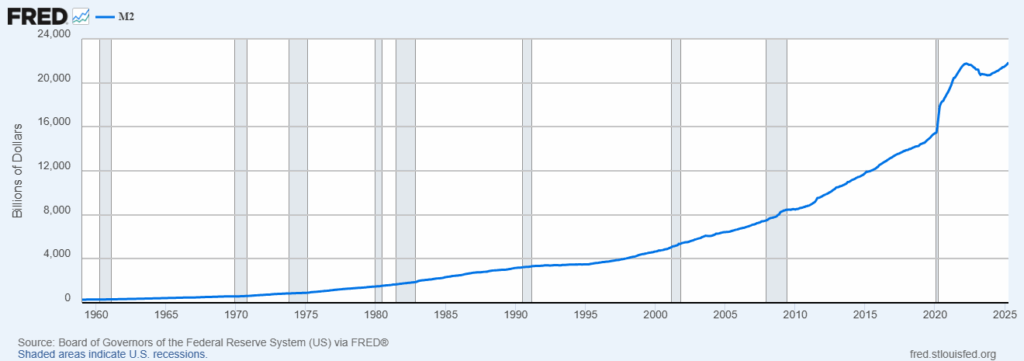
    The number to look at is the amount of money that gets created per year (monetary inflation). This is historically 7-10% per year. This means that the U.S. dollar loses 7-10% of its purchasing power per year.

    The supply of money in the U.S. has increased by 7,522% since 1952 ($21.5 trillion). Have wages increased by the same amount?
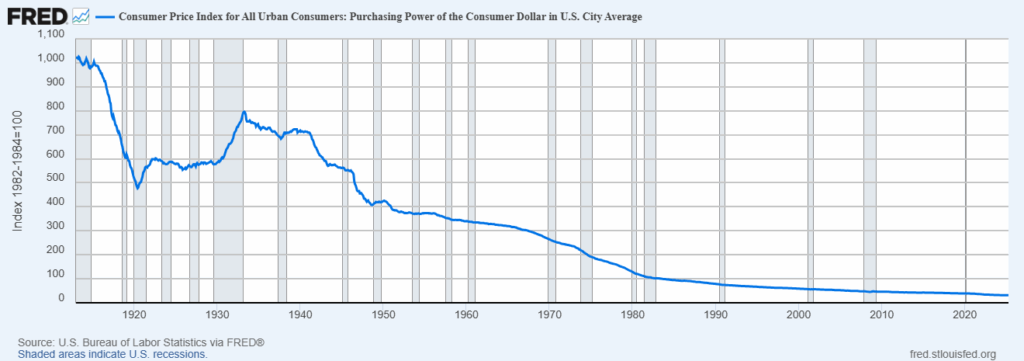
    The Purchasing Power of the U.S. dollar since its inception. 97% value lost.